I Listened To Every Punk-O-Rama and Here's My Review of Each One (Part 1)
I don't remember where I first encountered the term "punk rock", but I have a few distinct memories.
I'd gotten a Blink 182 CD for my birthday from my parents when I was around 11 or 12. I'd asked for it, but almost solely because my friend from church said he liked them - I don't think I'd ever even heard them. My parents had gotten me Dude Ranch because it was the only one that didn't have a parental advisory sticker, and if you want to know my mom's reaction to the "girl giving a horse fellatio skit," you're going to have to wait until I inevitably do a full Blink 182 listen-through (Ok, fine: she made me turn it off). Around the same time, I remember flipping the dial of my plastic portable CD/Radio player randomly until I ended up, almost by happenstance, on the frequency for the local alternative rock station (the song they were playing was "Renegades of the Funk" by Rage Against the Machine). I don't remember if I was doing this especially intentionally, but soon I was hooked on all of it, from the good (Dookie) to the thought-of-as-bad-until-recent-semi-ironic-re-evaluation (Limp Bizkit), to the eternally shit (3 Doors Down). Over the course of sixth and seventh grade, though, I started gravitating to the punkier bands. They were funnier, punchier, wrote catchier songs.
When I'd accompany my parents on shopping trips to places like Fred Meyers, I would ask to be dropped off to browse the electronics section. Sometimes I looked at the computer games, but usually I would browse the CD section, longingly gazing at the ones with "Parental Advisory" stickers that I wasn't allowed to buy. I would also look at the different compilations, which promised a bunch of bands on one CD. Among these would be the Punk-O-Ramas, which were always dirt cheap (and had no sticker), but also consisted almost entirely of bands I'd never heard of, with the exception of Bad Religion and Pennywise, who were sometimes played on the radio. But I would also get the sense that they weren't really for me; I was a shy, goofy kid who hung out with the Monty Python crowd. The people who were outwardly into "punk" at my middle school were mean, and the images on the covers seemed intense. I distinctly remember the one that had a tough looking kid with a black eye on it.
By eighth grade, I was in a new school - small, with an eighth grade class of about 30 kids. I didn't make any good friends there, and so freed from the tastes and preconceptions of a peer group, I was left to cultivate my musical tastes on my own. My old friends (who I think all got into Radiohead,) weren't there to steer me one way or the other, and the mean skater kids weren't there to threaten to beat me up or call me a poseur. So about mid-way through the year, at a Barnes and Noble in Corvallis, I bit the bullet and bought "Punk O Rama 7" for about 5 bucks, and listened to it on my discman as my mom drove me home.
The one two opening punch of "Fingers Crossed" by Millencolin followed by "Wayfarer" by Hot Water Music was like getting the greatest sugar rush I'd ever had. It was faster, catchier, more energetic then any of the punk bands I knew from the radio, and I fucking loved it. It felt like this entire musical underground had suddenly opened up to me, "a world hidden in the world" as Don Delillo describes Lee Harvey Oswald discovering leftist philosophers in the library, and in hindsight I honestly don't know whether it ruined my life or saved it. Changed it, in any case.
Anyway I decided to listen to all the Punk-O-Ramas as a 37 year old to see if they hold up.
PUNK-O-RAMA VOL 1
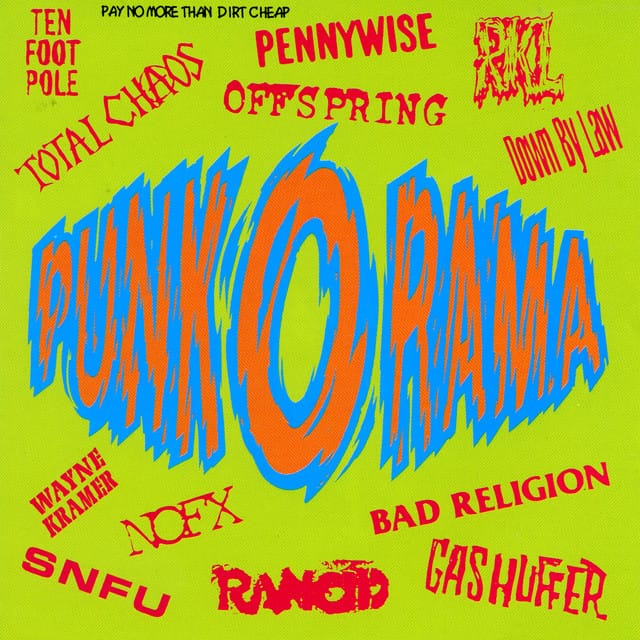
The Punk-O-Ramas were, of course, put out by Epitaph records as essentially an advertisement for their discography, a label started and owned by Bad Religion guitarist Brett Gurewitz, I think basically to put out Bad Religion records.
Right off the bat, we establish what I think of as the "Big 3" of these comps. Rancid, Bad Religion, and NOFX don't appear on every single one, but they are on most of them, and they sort of represent the three biggest pillars of this kind of hyper-frenetic California birthed skate punk. It's probably worth contextualizing that what we're talking about is "underground" relative to Green Day and Nirvana, but was still extremely popular for most of the 90s and sneered at by all variety of DIY purists from more homegrown scenes.
Bad Religion always sounded sort of utilitarian to me, with almost Spartan (Greeks, not the band "Sparta") power chords and melodies. They never quite grabbed me as a 14 year old, though it's probably worth viewing them in context: they're the oldest of the big 90s skate punk bands, starting all the way back in 1980, with more or less the same sound the whole way through (well, plus a sort of proggy detour early on that everyone hates but I think is sort of fun). Viewed in comparison to bands like Black Flag and Minor Threat, or even the early Descendents, they are a LOT more melodic, with like, actual vocal harmonies, while still channeling the speed and political angst of the hardcore bands of the time. The track opening this album is just fine, a nice quick encapsulation of the band's signature sound (with a fun "wah-hey in there too). It's interesting they went with a track from their 1988 classic Suffer and not one of the 5 albums they put out after.
Of all these bands, NOFX was my favorite as a teenager. I'm not sure what that says about me now, but it seems pretty clear that they took essentially what Bad Religion was doing (along with some of the more shreddy aesthetics of stuff like Rich Kids on LSD), and then made it extremely palatable to, say, a 14 year old boy. Some political lyrics, but then a lot of stuff that's just silly or crude for its own sake. The politics that they do express have a sort of libertarian "everyone is ridiculous except me" vibe (perfect for a young teenager's sensibilities). Greg Gaffin comes across like sort of an aloof professor, but Fat Mike is a very clear and exaggerated personality with amusing-to-annoying quirks and obsessions that he WILL make you know about if you listen to them. Musically, they take the harmonies and melodic sense of Bad Religion and amp it up, adding it ska and trumpets and a sensibility that I think was pretty obviously informed by Broadway musicals. They are also, it should be noted, tight as fuck, largely thanks to the powerhouse that is Eric "Smelly" Sandin's drumming. On their two offerings here, "Don't Call Me White" is one of their most popular tracks, but feels conceptually like a dated response to the perhaps overzealous PC types of the early 90s (a favorite target of theirs that... well, we can see where it all led, yeah?). Later, we get the sapphic romance "Liza and Louise," which always sounded sort of like a Cheap Trick to me, with it's more mid-range tempo and bendy guitar lines.
Rancid are way looser than the other two, with a more overt rock n roll influence - open chords and Chuck Berry guitar riffs, and slurred "drunk guy" delivery (though I think Tim was sober for most of Rancid's existence.) Listening to "Hyena," track 3 here, it strikes me that this really is some of the best rock n' roll ever made; loud, passionate, high energy, snarling distorted guitar.
I think I'd been worried going into this project that I would find that the thing I spent most of my teenage years obsessing over was actually complete shit, like I'd realize I was actually just listening to the bands that do the theme songs to Chuck E Cheese's commercials or something. And it is true that those elements that lent themselves to increasingly more commercialized forms of imitation - and earned them the ire of hardercore than thou types - are definitely present: catchy melodies, harmonies, frenetic energy perfect for an 8 year old to go tearing around a ball pit to. But, I mean, so is Little Richard, and it is is striking to me how comparatively raw these bands still sounded back then, before pro-tools and other high end production techniques eventually slicked a lot of the life out of them.
Speaking, of, the next track we get is from the Offspring, a great band on Epitaph, who then became increasingly unfocused as they got more and more mainstream. We used to call this "selling out," but I think it's often a result of bands legitimately trying to grow, and then just, you know, kind of sucking at it. It's awesome to hear how raw and sort of unpolished they are on their two tracks for this comp - I think I caught a part on "Jennifer Lost the War "where they lose the tempo a little bit, for example, just like all the best punk bands (being drunk 19 year olds recording records in like 2 days on shoestring budgets) do.
Pennywise is actually the only band to appear on all 10 Punk-O-Rama's plus the extremely short lived "Unsound" follow up series, and sound more or less like Bad Religion without the doctorate degree.
Each of these bands, being the tentpoles of the label, get two songs on the comp, so the rest is filled with what might be thought of as the "b-team," a more motley collection of bands that don't necessarily fit the apparently already established Epitaph mold, and may or may not show up in future installments. We kick this off with a track from Total Chaos, a classic street punk band who I actually had no idea put out three albums on Epitaph in the 90s, though this is the only Punk-O-Rama they're on. As per genre conventions, gone are the harmonies and catchy melodies, and the distortion suddenly sounds wayyy cheaper to me, though that might just be because they're overdriving it a lot more. We get a garage punk band called Gas Huffer, who will show up again, and then a track from Oxnard legends Rich Kids on LSD, a band I like in theory, being so influential to the Epitaph sound, but that in practice just sounds like all the frenetic riffs without the melodies.
Down By Law is the main project of Dave Smalley, who was a one time vocalist for classic bands DYS, Dag Nasty, and All, but honestly I most remember him for starting "Conservative Punk," a website and.... movement I guess?... back in the Bush years as a counterpoint to Fat Mike's "Punk Rock Voter" campaign. Thankfully, the track here, "Bright Green Globe," seems to have a more general "think for yourself" message to it (and even has a dig at Rush Limbaugh... I think it's a dig, anyway), but stay tuned on this one because they will be back...
Other offerings here include Wayne Kramer, the legendary guitarist of the classic Detroit proto-punk band MC5, establishing early a precedent that Epitaph would also serve as the home for legends who are maybe trying to figure out what to do with themselves. It's kind of a neat psychedelic garage track, though definitely well-trod territory for this guy.
Ten Foot Pole (and later Punk O Rama mainstays Pulley) are fronted by Scott Radinsky, a Major League Baseball player. I don't know enough about baseball to know if he's any good or not, though his wikipedia page seems to focus on it more than his punk career. We're back to pretty classic Epitaph poppy skate punk with this one. Gotta love those hyperfast palm mutes.
We finally end things with SNFU, a classic hardcore band. I think this really establishes the template for these comps, and for the Epitaph roster as a whole: the core tentpole bands, a steady collection of solid but kind of derivative second stringers, an alternate identity as the home to a lot of garage punk bands, and a resting place for various legends who are perhaps a bit past their heyday. Later on, we'll get some curve balls, but this pretty much establishes the pattern, which brings us to
PUNK-O-RAMA 2
(Note that if I've already written about a band, I'm skipping them unless I have something to say about a specific track).
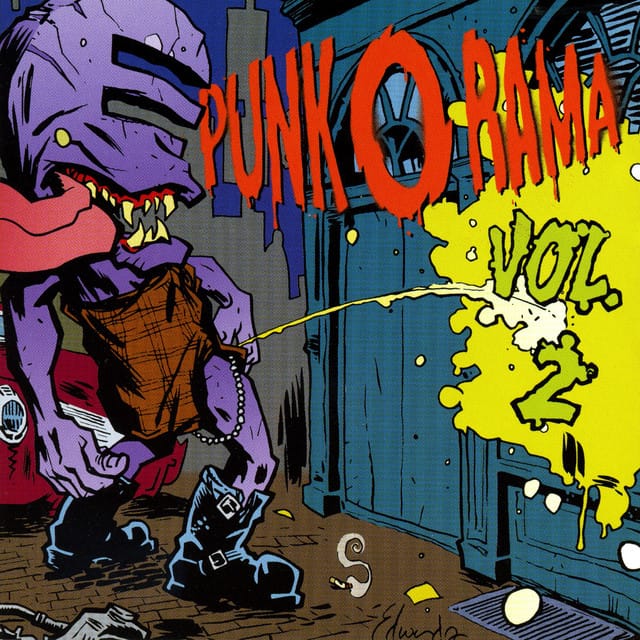
The most significant change between Punk-O-Rama Vol 1 and 2 is actually the price; whereas the initial entry was priced like a regular full length, this one was somewhere around 4 bucks. I don't have access to Epitaph's sales data or anything, but I have to imagine this made a nice difference, considering that these were bands that a lot of kids (such as myself) hadn't actually heard before, and also that these CDs were sold at pretty much any major CD retailer, presumably making this a perfect gateway toward getting a lot more kids into this music.
So, into the music we go, kicking things off with a 35 second song from the Descendents, a band that like Bad Religion managed to straddle the two eras of early 80s hardcore and early 90s skate/pop punk. Bad Religion solidified many of the staples of the 90s style, but the Descendents definitely codified the tone of many of the bands, alternating snottiness with introspection (and a heaping of self-loathing as well). People make a lot about all the songs about girls and unrequited love and all that, but I think equally important are the observations on the minutiae of everyday life (of which this song, "Coffee Mug," is a case in point).
We are also quickly introduced to Scott Radinsky's new band Pulley, which would be mainstays of the series from here on out. Did we need 70 bands that sounded like Bad Religion? Maybe not, but on the other hand, I would argue that we could really use a few these days. One for every high school and middle school, at least.
I believe this is the only Me First and the Gimme Gimme's appearance on a Punk-O-Rama, a punk rock supergroup that at the time would have featured members of the No Use For a Name, NOFX, Lagwagon, Good Riddance, and the Swinging Utters (all bands on Fat Mike's own label, Fat Wreck Chords). It was a staple of the genre to have bands doing punked up covers of various "cheesy" 70s and 80s songs (hell, even Propagandhi do it on their first album), most of which are pretty ehhhhhh... (the irony being that a lot of these bands were ultimately more derivative and disposable than the thing they were making fun of), but what sets the Gimme's apart are their impeccable song choice, and Spike Slawson's fairly soulful vocals. The best Gimme's tracks are legitimately good songs, played with pizzaz, the punk aspect simply adding another layer to some already solid bones. All that said, this "Only the Good Die Young" cover is not one of my favorites, and ultimately comes off as flatter and less passionate than the original. What can I say, it's my karaoke song, I got a lot of feeling for it!
We get garage rock from a band called the Humpers - sorry folks, I'm just not as into the garage rock thing and every time one of them shows up, it sort of slows down the momentum for me.
Then we get a few more big first appearances, namely the first Millencolin and Voodoo Glow Skulls songs. Millencolin never quite got the status of a NOFX or Rancid, but to me they rank up their at the top of the pack. "Bullion" perfectly captures the particular angst of being in your early 20s to me. I remember it well: I had some of the best friends I'd ever have, I could drink like a champion and still go to work the next day. And yet I was so bummed out so much of the time.
On kind of the far other side of things, we have the Voodoo Glow Skulls, a ska punk band but one that sounds considerably more driving and ominous than "ska punk" usually connotes, like a demented mariachi band, with a heavy So-Cal Chicano influence.
I've never heard of The Joykiller, but apparently it was something of a supergroup with members of TSOL and the Gun Club. Fun, fast paced rock n roll song. The piano gives it a bit of a New York Dolls feel. Then we actually do get a track from the legendary TSOL, followed by the almost as equally legendary Portland hardcore band Poison Idea. Both great bands, but this stuff never stands out as much on these comps to me. "Code Blue" has some fun lyrics at least (about necrophilia).
I think "Thought Control" by Dead Fucking Last is the first "exclusive" track on one of these comps, and sounds like it was recorded in a tin can. It's interesting to me how much the production quality varies on these different albums that are all on the same label.
The closer is New Bomb Turks, I think the most storied of all the Epitaph garage punk'n'roll bands. I don't know that every garage punk band has the kind of "50s rock n roll" idolization, but I think this band definitely does - I mean, the track's about a fucking jukebox. It all seems fun in small doses, but I can mostly take or leave it.
PUNK-O-RAMA 3
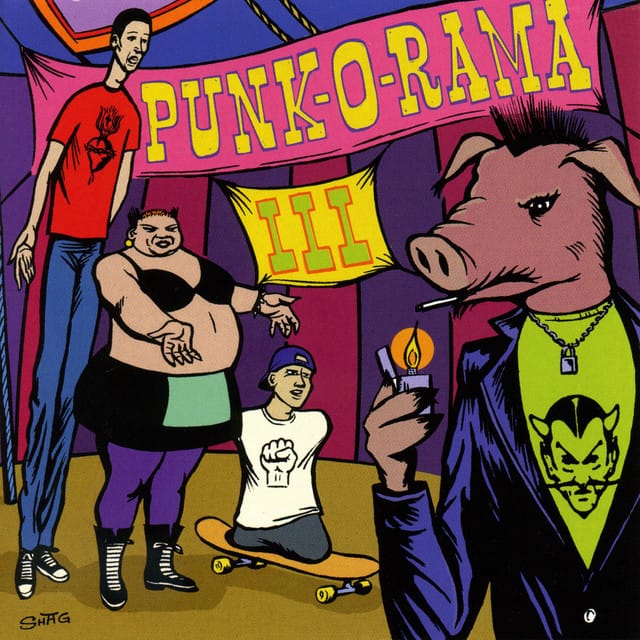
Punk-O-Rama 3 opens with an absolute banger of a NOFX song, "We Threw Gasoline on the Fire and Now We Have Stumps For Arms and No Eyebrows." The 155 Podcast covered this one, and I think they got it right: this has all the best parts of NOFX in it, with minimal of the annoying parts. Sweeping, almost theatrical melodies, shifting movements throughout the song, the fast as hell forbidden beat, Fat Mike in the mode where he's sort of poetically lamenting the olden days of the punk scene, before he started making every single song an examination of his own narcissism and bad habits. Just a fire track.
We then get a trio of important Punk-O-Rama debuts, starting with the Dwarves. I'm honestly not sure how to take the Dwarves in this post-"woke" world. There were a lot of hyper-PC bands in the 90s punk scene (which honestly the Epitaph world barely touches for the most part), and then there were bands like this, that sort of embraced the idea of being sleazy, pussy obsessed goons. It can be kind of fun, I guess, but it becomes significantly less so when you realize it's not necessarily kayfabe for everyone. "Everybody's Girl" is not really that bad, just horny. Their Epitaph stuff is considerably more melodic than their 80s material, kind of bubbly garage punk, whereas the older material were just short blasts of weird surreally offensive hardcore like "Insect Whore" (which is about having sex with insects). I dunno, I just never really liked the shock punk stuff either, which almost always has a real misogynistic undercurrent at the end of the day.
We move on to All. All is the exact same band as the Descendents, but with a different singer. In fact, a rotating cast of singers. Which means they are a very good band, but also really highlights how certain things like a highly charismatic and idiosyncratic frontman really can make the difference between a very good band and a fucking great one.
There's a lot of spectrums that we're getting exposed to here; just a second ago I noted the spectrum between super-PC punk bands and super NOT PC punk bands. Another one would be the spectrum of super sarcastic bands and super sincere bands, with Bouncing Souls being maybe the shining example of the latter. They were always catchy but sort of meat and potatoes, but the songs also just drip with this bright eyed exuberance, even when they're singing about times being tough. This extends to the act of playing music itself, the belief that it does actually really really matter; they are, after all, the true believers. I used to believe as well; in my better moments, I still do.
We then get to a string of hardcore punk bands, including H20, Straight Faced, Union 13, and Agnostic Front. Of these bands, Agnostic Front stands out to me the most, and seems to best capture the essential pleasure of hardcore punk, which is a group of sweaty men all chanting in a room together. Basically soccer hooliganism for US kids. Roger Miret's vocals definitely add an element of pathos as well that is sometimes missing from bands like this.
In the middle of the hardcore set comes a song from Zeke, which is a little bit more of a punk n' roll band ala the New Bomb Turks. This brings us to our extended section of various legends, oddballs, and all the other garage punk bands they wanted to include (which does include the New Bomb Turks). This kicks off with a track from the legendary rockabilly band the Cramps - it's interesting how many bands ended up putting out a few things on Epitaph, - then the Humpers, Wayne Kramer, and Gas Huffer, then return to poppy skate punk, mostly from the usual stalwarts, but with a few newcomers as well. These include the Red Aunts, an all lady band (I think the first on one of these comps - this side of the punk world was definitely still a boys club, unfortunately), Osker, and I Against I. All just fine but nothing that stands out to me.
Finally, I did say I would return to discussing Down By Law, and here we are. "No Equalizer" is one hundred percent covert conservative propaganda. It's a catchy song, with a hint of that great wistfulness that I associate with bands like Dag Nasty... but yeah. Just like Brad Bird's The Incredibles, it's about how attempts to create a more equitable world are doomed to fail, a classic move by Republicans to avoid actually trying (and thus preserve existing hierarchies). I wonder what Dave Smalley thinks about it all these days.